
Recycling and Sustainability for Commercial Waste Teddington
At the heart of our approach to commercial waste in Teddington is a clear commitment to creating an eco-friendly waste disposal area and a lasting sustainable rubbish area for local businesses. By aligning practical collection services with borough-level waste separation schemes and reuse partnerships, Commercial Waste Teddington works to reduce landfill, lower emissions and promote circular economy principles for shops, offices and trades across the area.
 Our service model recognises the Richmond upon Thames and neighbouring boroughs' approach to waste separation: dedicated streams for paper and card, separate glass and metal collections, mixed recycling for certain plastics and cans, plus food and garden waste collections where available. We support businesses to adopt these separation routines on-site so that recyclable materials enter the correct local Materials Recovery Facilities (MRFs) and composting or anaerobic digestion plants rather than general waste.
Ambitious Recycling Percentage Target and Reporting
We have set a measurable recycling percentage target of 65% commercial diversion from landfill within five years across the Teddington business community. This target is tracked quarterly using weighbridge data at local transfer stations and regular audits of mixed and segregated streams. The target focuses on both volume reduction and improved quality of recyclables — reducing contamination ensures higher yields at the resource recovery facilities.
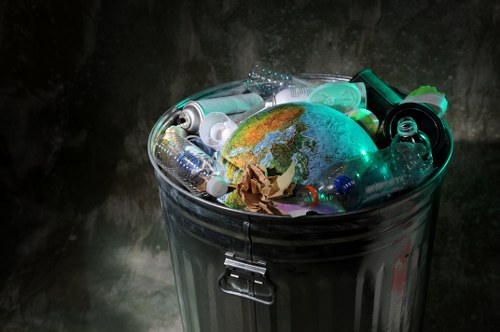 To support the target, we encourage businesses to adopt straightforward separation policies and to prioritise materials with strong markets for reuse. Simple changes like segregating clean cardboard at source and maintaining separate containers for food waste convert easily into higher recycling percentages and lower disposal costs.
Local Transfer Stations and Resource Recovery
Waste collected from Teddington businesses is consolidated at nearby local transfer stations and MRFs serving Richmond and adjacent boroughs. These transfer hubs are the link between street-level collection and regional processing: consolidation reduces vehicle mileage, while modern MRF sorting technologies increase the volume of materials recycled. Where appropriate, materials are routed to anaerobic digestion for food waste or to specialist processors for electronic and hazardous streams.
We also operate a dedicated fleet of low-emission vehicles that complements consolidation: a mix of electric vans for short urban runs and Euro-6 low-NOx light trucks for heavier loads ensures that the logistics footprint is minimised across the transfer-to-processing chain.
Partnerships with charities and reuse organisations are a cornerstone of our sustainability programme. By diverting usable items to local groups, we extend product life and support community needs.
Examples of charity and community collaborations include working with local furniture refurbishers, textile reuse projects and food redistribution networks. Typical items redirected from the commercial stream include:
- Office furniture and shelving suitable for refurbishment and reuse.
- Surplus electrical equipment and white goods that are assessed, repaired and resold or responsibly recycled.
- Textiles and uniforms collected for community schemes and social enterprises.
- Edible but unsold food products channelled to accredited food charities and redistribution organisations.
These partnerships decrease the tonnage needing disposal and enhance social value locally, reinforcing the role of commercial recycling services in Teddington beyond pure waste management.
Designing a Sustainable Rubbish Area on Your Site
Practical site design is essential for an effective sustainable rubbish area. We advise businesses to create designated bays with clear signage, colour-coded containers and sheltered storage to keep dry recyclables clean. Training for staff on correct sorting protocols significantly reduces contamination and improves the economics of recycling.
On-site measures typically include:
- Clearly labelled containers for paper/card, glass, mixed recycling, food and general waste.
- Segregated secure storage for hazardous or electrical waste awaiting specialist collection.
- Compactors or balers for high-volume cardboard and plastics, where space and volumes justify them.
Low-Carbon Vans, Route Optimisation and Emissions Reductions
Our low-carbon vans form an integral part of lowering the environmental impact of commercial collections. The fleet includes battery-electric vans for urban collection rounds, plug-in hybrids for mixed routes, and modern Euro-6 engines for heavier transfers where required. Combined with smart route planning and consolidation at transfer stations, these measures cut fuel use, reduce emissions and improve air quality in Teddington's commercial zones.
 Businesses that choose to participate in targeted recycling programs also benefit from operational savings. Reducing general waste volumes lowers disposal fees, while improved recycling streams can generate modest revenue or cost offsets when materials have strong market value. The combined environmental and financial gains make an eco-friendly waste disposal area a pragmatic business decision.
In short, Teddington commercial waste services aim to deliver an integrated, measurable and community-minded approach: ambitious recycling percentage targets, close collaboration with local transfer stations and charities, and a modern low-emission fleet all support a resilient, sustainable rubbish area for local industry. By aligning on-site practices with borough waste separation rules and taking advantage of reuse pathways, businesses can be part of a cleaner, lower-carbon future for Teddington.
